June 8th, 2026
6 min readStrategic Infrastructure Selection: Aligning AMRs & Conveyors with Throughput Goals
Balance AMRs and conveyors to create the right material handling solution tailored to your specific throughput and layout needs.
Balancing fixed infrastructure and autonomous agility for long-term throughput.
Evaluating AMRs vs conveyors through a bespoke Distribution & Fulfillment Design framework is the most critical technical assessment for current facility operations. We look past the hardware to focus on how your facility’s transport strategy dictates your long-term workflow stability and capital efficiency. We assist leadership teams in analyzing their specific requirements to ensure that the chosen technology aligns with their business objectives. This process prevents the common pitfall of selecting equipment based on immediate costs rather than long-term operational resilience. We recognize that your facility requires a transport architecture that supports both your current fulfillment volume and your anticipated growth.
Executive Summary
Choosing between fixed conveyor infrastructure and autonomous mobile robots involves balancing predictable, high-volume movement against the need for operational flexibility. We evaluate your specific SKU profiles and facility footprint to ensure your automation investment delivers measurable throughput gains. Our approach focuses on aligning your mechanical assets with your organization’s growth targets to prevent costly mid-cycle reconfigurations.
Key Takeaways
- Conveyors provide consistent, high-volume movement for stable SKU profiles.
- AMRs offer modular agility for dynamic, high-variability workflows.
- Hybrid integration optimizes both throughput density and system adaptability.
- Strategic analysis of infrastructure rigidity in material handling
- How we prioritize capital expenditure optimization for automation systems
- Why warehouse automation interoperability and WES integration are critical
- Methods for implementing scalable fulfillment network design strategies
- Conducting a lifecycle cost analysis for conveyor vs AMR transport
- Get in Touch: Driving operational resilience
Strategic analysis of infrastructure rigidity in material handling
The fundamental challenge in facility design lies in reconciling the need for high-velocity throughput architecture design with the reality of market volatility. When organizations prioritize short-term throughput targets without considering long-term flexibility, they often install rigid conveyor systems that cannot adapt to changing product lines or seasonal SKU shifts. This approach creates significant technical debt, as reconfiguring fixed infrastructure involves substantial downtime and capital reinvestment.
As your systems integrator, we move beyond simple equipment selection. We analyze your floor-level data to determine where fixed assets like conveyor loops provide the most stability and where autonomous mobile robots offer the necessary pathing agility. The goal is to avoid the trap of choosing technology based on initial installation costs alone. Instead, we focus on how your transport assets function within your broader material handling return on investment analysis. By identifying bottlenecks in your current processes, we can design a transport architecture that supports your business model today while remaining adaptable for future expansion.
How we prioritize capital expenditure optimization for automation systems
Effective capital expenditure optimization for automation systems begins with a granular audit of your order profiles. If your facility processes high-volume, standardized goods that follow a repetitive path, conveyors typically offer a lower cost per unit moved over the lifecycle of the equipment. We design these fixed systems to minimize decision points and maximize continuous flow. However, we also calculate the cost of potential future modifications.
If your market requires frequent adjustments to fulfillment workflows, we ensure that the fixed components are modular and capable of being repurposed or integrated with other technologies. By treating capital expenditure as a long-term resource allocation rather than a one-time purchase, we help you avoid over-investing in rigid systems that may become constraints.
Why warehouse automation interoperability and WES integration are critical
Technology deployment frequently fails not due to hardware limitations, but because of software silos. True warehouse automation interoperability and Warehouse Execution System (WES) integration require that your fixed conveyors and AMRs communicate within a unified data environment. We ensure that your WES manages the handoff between disparate transport types seamlessly.
Whether an item is moving along a belt or being carried by an autonomous unit, the status of that item must be visible in real-time. This level of synchronization prevents traffic congestion and prevents inventory loss. When we design your facility, we focus on the data layer as much as the physical layer, ensuring that your software stack can orchestrate complex movements across both fixed and autonomous assets.
Methods for implementing scalable fulfillment network design strategies
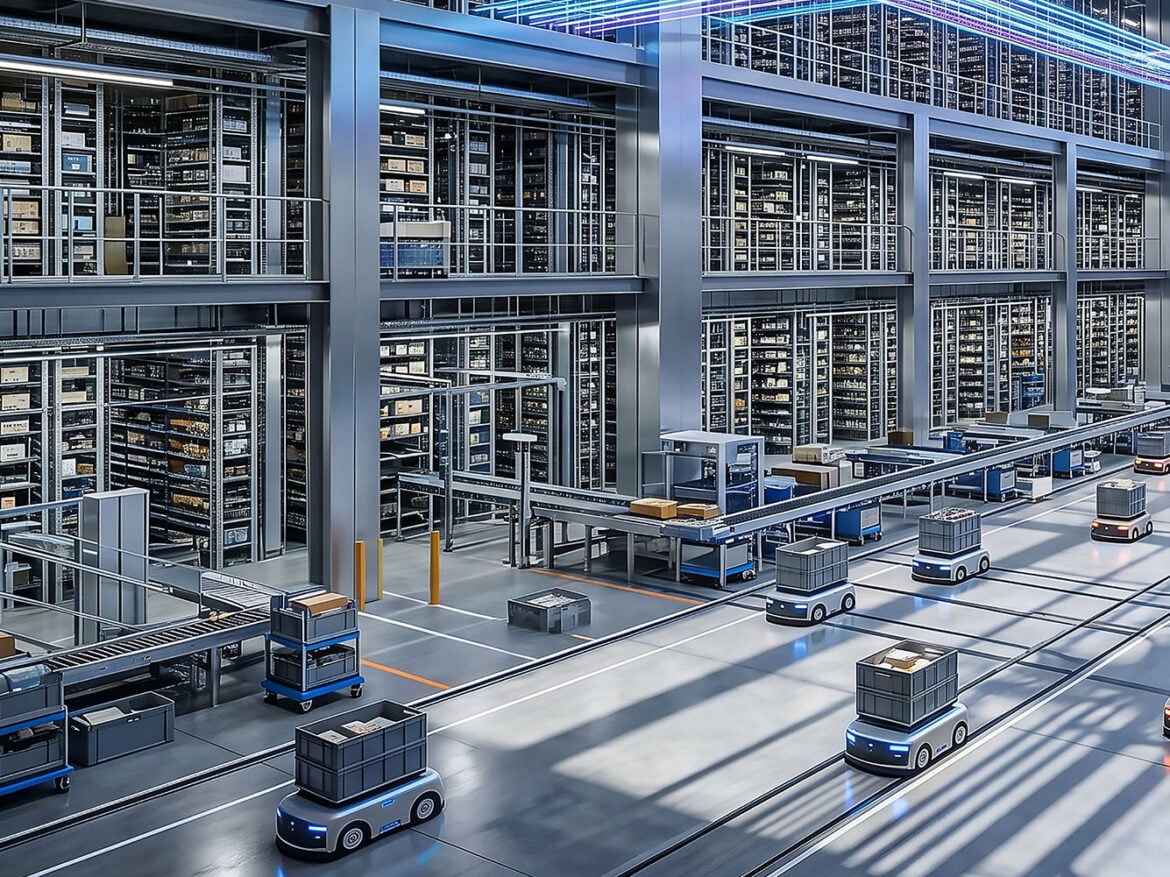
We utilize scalable fulfillment network design strategies to ensure your infrastructure evolves alongside your business growth. In many cases, the most resilient solution is a hybrid model. We often recommend using conveyors for your main transport arteries where high-volume, consistent movement is required. Simultaneously, we integrate autonomous mobile robots to handle replenishment, secondary processing, or edge-case exceptions.
This combination allows you to maintain high throughput density while leveraging the agility of autonomous units. By creating this multi-modal transport network, we prevent your facility from hitting capacity limits as your volume increases. This design approach allows us to scale your operations incrementally, adding mobile assets as needed without requiring massive, facility-wide overhauls.
Conducting a lifecycle cost analysis for conveyor vs AMR transport
The true value of a transport strategy is visible only through a comprehensive lifecycle cost analysis for fixed vs autonomous transport. We evaluate metrics that go beyond the initial price tag, including long-term energy consumption, routine maintenance of mechanical parts, software licensing, and the labor required to manage system exceptions. Fixed systems typically require less energy per unit moved but involve higher installation labor and more significant disruption when changes occur.
Autonomous systems demand a higher upfront investment in fleet management infrastructure but offer superior cost-efficiency when your workflows require frequent reconfiguration. We provide these data-driven comparisons to ensure that your decision aligns with your five-year or ten-year operational budget, giving you clarity on the total cost of ownership before you finalize your procurement strategy.
Get in Touch: Driving operational resilience in automated centers
Operational resilience in automated fulfillment and distribution centers is not an inherent trait of your equipment but the direct result of precise infrastructure alignment with your throughput targets. We secure this performance through senior-led execution and total system accountability, ensuring your facility architecture withstands the stress of real-world demand. Our approach eliminates technical silos and ensures your transport systems remain stable, performant, and scalable regardless of your volume fluctuations.
Get in touch with our specialists today to to review your facility’s throughput requirements and determine the right balance of AMR and conveyor infrastructure for your long-term operational success.
IndPro Services
Since 1990, IndPro specialists have been helping warehouse and distribution leaders turn technical complexity into operational certainty. Whether you are navigating the selection of a new software layer, integrating advanced robotics, or stabilizing the performance of a high-throughput distribution network, IndPro brings senior-led execution to every phase of the lifecycle. As a leader in material handling automation, we remain accountable to the measurable results that ensure your systems support long-term growth and sustained efficiency.
Automate. Evolve. Succeed.
Hands-on leadership. Accountable partnerships. Measurable results.