
November 9th, 2026
8 min readWarehouse Automation Maintenance: Engineering Uptime Through Spares and PM Discipline
Protect equipment ROI through criticality-ranked spare parts, duty-cycle PM schedules, CMMS discipline, and controlled recovery protocols that eliminate unplanned downtime.
How to protect throughput and ROI through pre-launch maintenance architectures.
Automated material handling systems earn their financial return strictly while they remain available to run. A high-speed conveyor line, shoe sorter, automated storage and retrieval system (AS/RS), robotic palletizing cell, or goods-to-person (GTP) network can pass every commissioning acceptance test and still stall facility output twelve months later when maintenance planning starts after the first major mechanical failure.
IndPro Services eliminates post-launch reliability gaps by integrating warehouse automation maintenance, critical spares strategy, and condition-based preventive schedules directly into initial system architecture.
Executive Summary
Warehouse automation maintenance succeeds when engineering teams design reliability, spare parts accessibility, and telemetry diagnostics into the system before commissioning begins. Waiting until equipment degrades erodes throughput capacity, inflates emergency freight costs, and stalls capital payback across distribution and manufacturing operations.
- Rank assets by operational impact, then align PM effort and spare parts to that risk.
- Build PM schedules around OEM guidance, runtime, cycles, environment, and actual failure history.
- Track MTBF, MTTR, planned versus reactive work, PM compliance, and critical-spares availability as operating metrics.
- Uptime problems usually start before the breakdown.
- 5 pillars to build the maintenance program around the recovery time.
- Get in Touch
Uptime problems usually start before the breakdown.
Unplanned automation outages originate in pre-launch planning gaps long before a motor, sensor, or drive fails on the floor. According to MultiSensor AI’s Uptime Economy: 2026 Report (as reported by Supply Chain 24/7), over 90% of distribution and logistics leaders approved or deployed automation despite lacking full internal readiness to maintain it, and 97% expanded facility automation over three years without matching gains in maintenance capability.
That readiness gap exposes operations through three specific disconnects:
- Generic preventive maintenance (PM) checklists divorced from actual equipment run hours
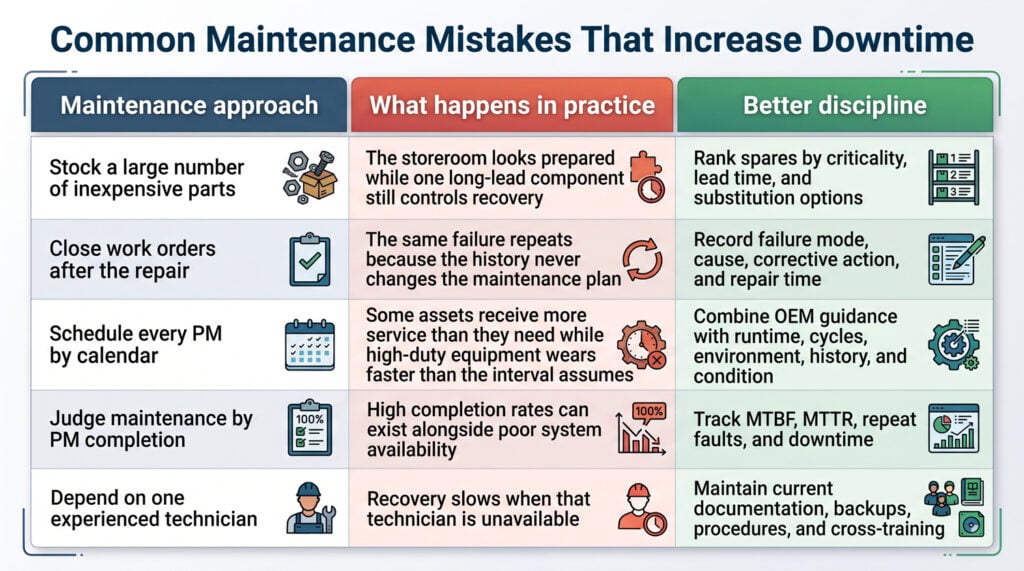
- Storerooms stocked with inexpensive hardware while missing a single long-lead encoder or variable frequency drive (VFD)
- Missing electrical schematics or PLC backups that stall technician troubleshooting mid-shift.
A Computerized Maintenance Management System (CMMS) delivers ROI only when repair history triggers structural changes to the maintenance plan. Linking asset lists, PM schedules, spare parts inventory, and fault logs converts daily breakdowns into permanent fixes:
- Recurring faults update future PM tasks
- Extended repair times trigger critical spare additions
- Repeated emergency calls prompt engineering reviews.
Closing a work order marks the end of the physical repair and the start of the next reliability improvement.
5 pillars to build the maintenance program around the recovery time.
Effective maintenance programs allocate engineering hours and working capital directly to the assets that govern facility throughput and recovery speed.
1. Rank assets by what happens when they fail.
Mapping end-to-end material flow exposes which equipment stops an entire shift versus which zones permit manual bypass. Assets with built-in redundancy or adjacent transfer paths cause minimal disruption during a fault, whereas single-point-of-failure subsystems lacking an alternate route halt outbound shipping across the building. Maintenance priority, spare parts capital, and technician diagnostic readiness belong squarely on assets that carry the highest operational consequence.
2. Stock the parts that actually get the system running again.
Effective spare parts allocation starts with the components that govern recovery time rather than total storeroom square footage. Carrying hundreds of low-cost items ties up working capital while leaving outbound throughput exposed if a single long-lead control or drive assembly is missing during a peak-shift outage.
IndPro separates routine wear consumables from recovery-critical spares by weighting five financial and engineering criteria:
- Operational Consequence: The hourly cost of missed carrier cutoffs and idle labor while waiting for a replacement.
- Supplier Lead Time: Current OEM manufacturing and freight windows for specialized assemblies.
- Installed Quantity and Commonality: Total units operating on the floor and interchangeability across zones.
- Repairability: Whether failed assemblies require full replacement or support modular component swaps.
Replenishment discipline protects that capital investment over the lifecycle of the system. Automated minimum-maximum reorder triggers inside the Computerized Maintenance Management System (CMMS) ensure procurement replaces consumed critical spares immediately when the last unit leaves the shelf.
3. Build PM schedules around the way the equipment actually runs.
Sustainable preventive maintenance starts with OEM baselines and adapts directly to actual facility runtime, load stress, and sensor condition data. Designing that schedule requires balancing three operational priorities:
- Operating Stress Calibration: OEM maintenance intervals provide a starting baseline, while actual facility duty cycles dictate true equipment wear rates. Multi-shift operating hours, start-stop cycles, product load, vibration, ambient temperature, and airborne contamination degrade assets far faster than a single-shift schedule in a clean facility.
- Mechanical and Controls Balance: Mechanical preventive maintenance protects throughput by concentrating technician labor on active wear assemblies and structural alignment rather than static hardware. Controls and electrical systems require equal discipline, since cabinet cooling, power supplies, industrial networks, sensor alignment, fault logs, and controller backups govern system availability just as directly as mechanical drives.
- Condition-Based Telemetry: Condition monitoring sharpens those schedules by capturing early warning signals before an operator detects a problem. Tracking vibration, thermal output, motor current, and operating speed exposes bearing, motor, and gearbox deterioration early enough to intervene during planned downtime rather than reacting to mid-shift failures.
4. Measure whether reliability is actually improving.
True maintenance ROI comes from sustained system availability and lower operating expenses rather than high preventive maintenance completion percentages. A team can complete 100 percent of its scheduled tasks and still miss carrier cutoffs when recurring bottlenecks stall outbound flow.
Executive leadership needs reliability metrics that expose both equipment durability and operational recovery speed:
- Mean Time Between Failures (MTBF): Tracks how reliably a repairable asset runs between breakdowns.
- Mean Time to Repair (MTTR): Measures total restoration speed from initial fault to full throughput.
Engineers express inherent availability through a standard ratio: Availability = MTBF ÷ (MTBF + MTTR)

That calculation captures technical wrench time, yet your shipping dock feels every minute of the administrative delays surrounding the repair. A technician might spend twenty minutes swapping a failed component and another full hour hunting down the spare part, pulling electrical drawings, calling support, or clearing restart interlocks. Leadership needs to bring those hidden delays into the reliability conversation alongside repeat fault rates, planned-versus-reactive labor splits, and critical-spare availability, because a recurring breakdown that gets cleared quickly still bleeds throughput.
Maintenance performance clicks financially the moment you tie floor-level downtime directly to overtime hours, missed carrier cutoffs, emergency service callouts, and expedited freight. Putting real dollar figures beside those operational hits lets you weigh them honestly against your investments in spare inventory, condition monitoring, and technician training. Having that clear P&L comparison gives you a far truer measure of maintenance ROI than simply celebrating a high PM completion score.
5. Make safe recovery part of the design.
Fast recovery still has to be controlled recovery. Pre-engineering safety protocols, verified system backups, and clear operational ownership before an emergency occurs allows your team to isolate energy safely and restore throughput without reconstructing system architecture while orders sit stalled on the line.
Good documentation keeps high-pressure troubleshooting from turning into guesswork by giving technicians immediate access to five essential records at commissioning:
- Asset-specific lockout/tagout (LOTO) procedures
- Current electrical and controls schematics
- Verified PLC and HMI program backups
- Step-by-step system restart sequences
- Direct vendor and internal escalation contacts
When outside service engineers step onto your floor, establishing upfront who owns the equipment, who controls energy isolation, and who holds authority to return the line to service keeps both your team safe and your recovery timeline predictable.
Get in Touch: Protect the automation investment with uptime discipline.
Automation maintenance starts during design, long before the first emergency work order.
IndPro helps operations address maintainability through critical-spares planning, PM structure, controls documentation, condition monitoring, recovery planning, and a clear understanding of which assets carry the most operational risk.
The real test comes when volume is high and a critical component fails. The operation should already know what stopped, how to work on it safely, which part is required, where that part is located, and how to get the system back into production.
That level of preparation is what turns maintenance from a reaction to a reliability program.
Do not wait for an emergency breakdown to reveal gaps in your spare parts inventory or PM schedule.
Partner with IndPro Services to evaluate asset criticality, align preventive maintenance with real duty cycles, and build a recovery-ready maintenance framework. Schedule an Automation Reliability Assessment Review.
IndPro Services
Since 1990, IndPro has stood as a premier leader in material handling automation and supply chain logistics, delivering expert integration for manufacturing, fulfillment, warehousing, and distribution operations nationwide. Backed by an active GSA Contract, we provide senior-led technical execution and system lifecycle support to U.S. military, government entities, and commercial enterprise leaders.
Automate. Evolve. Succeed.
Hands-on leadership. Accountable partnerships. Measurable results.